Ecommerce bookkeeping involves tracking and managing the financial transactions of online businesses, from sales revenue to operating expenses. In the fast-paced and competitive world of ecommerce, accurate bookkeeping isn’t just an administrative task — it’s the backbone of informed decision-making and growth. Effective bookkeeping helps ecommerce business owners understand their financial health, optimize spending, prepare for tax season, and plan for future growth.

Whether you’re a small online retailer or a large ecommerce brand, proper bookkeeping practices are essential for navigating the complexities of digital business. MonkTaxSolutions specializes in helping ecommerce businesses streamline their financial processes, ensuring accuracy and compliance with U.S. regulations. This guide explores the essentials of ecommerce bookkeeping, focusing on best practices, tools, and strategies tailored for businesses in the USA.

Why Bookkeeping is Crucial for Ecommerce Success


In ecommerce, profit margins can be tight, and a minor oversight in finances can result in major losses. Through bookkeeping, business owners can get a clear picture of their financial health, track revenue and expenses, and monitor their cash flow. Financial insights derived from bookkeeping reveal areas of overspending, high-performing products, and opportunities to improve efficiency.

MonkTaxSolutions provides tailored financial reports that break down revenue, expenses, and profit, offering clear insights that help you make informed decisions about your business’s direction.

Preparing for Tax Obligations


Ecommerce businesses in the USA must comply with various tax regulations, from income tax to sales tax. Bookkeeping is essential for tracking taxable income, eligible deductions, and potential tax credits. Proper record-keeping throughout the year makes tax season much smoother, reducing the risk of errors and potential audits by the IRS. Regular bookkeeping also helps businesses stay up-to-date with changes in tax laws, ensuring compliance. MonkTaxSolutions offers expert tax planning and compliance services, helping businesses reduce tax liabilities and stay compliant.

Key Bookkeeping Basics for Ecommerce Businesses


Income and Expense TrackingIncome and expense tracking is the foundation of bookkeeping. Ecommerce businesses handle revenue from multiple sources — sales, returns, shipping fees, and promotions. Similarly, expenses may include inventory costs, shipping, marketing, and platform fees. Accurately recording each transaction is crucial for calculating profit and loss, setting budgets, and managing cash flow effectively.

MonkTaxSolutions provides an all-in-one solution for income and expense tracking, allowing ecommerce businesses to monitor each financial transaction across various channels and gain a consolidated view of their profitability.

Inventory Management in Bookkeeping

For ecommerce businesses, inventory represents a significant investment and must be accounted for properly. Bookkeeping for ecommerce inventory includes tracking purchases, sales, and any write-offs due to damage or obsolescence. Accurate inventory bookkeeping ensures that the value of assets reflects the real-time state of the business, helping owners make informed decisions about reordering, discounts, and restocking. MonkTaxSolutions can help businesses set up efficient inventory tracking systems, ensuring that they stay on top of inventory costs and valuation.

Setting Up an Effective Bookkeeping System


Choosing the Right Accounting Software

Ecommerce bookkeeping can be complex, with high transaction volumes and a need for detailed reports. Many ecommerce businesses rely on accounting software tailored to online sales, such as QuickBooks, Xero, or FreshBooks. The right software should be able to handle multi-channel transactions, automate data entry, and integrate with ecommerce platforms. Choosing accounting software that aligns with your business needs can save time and reduce errors. MonkTaxSolutions assists businesses in choosing and implementing the best accounting software for their unique needs, helping them integrate their software with popular ecommerce platforms for streamlined operations.

Integrating Ecommerce Platforms with Accounting Tools

Integrating your ecommerce platform (like Shopify, Amazon, or WooCommerce) with accounting software streamlines bookkeeping. This integration automatically imports transaction data, reducing the need for manual entry and lowering the risk of errors. Many accounting tools also support integrations with payment gateways, POS systems, and inventory management software, providing a unified view of finances.

With MonkTaxSolutions’s support, ecommerce businesses can efficiently link their platforms and accounting tools, ensuring real-time data synchronization for accurate and effortless bookkeeping.

Best Practices for Ecommerce Bookkeeping in the USA


Staying Compliant with IRS Regulations

The IRS has strict guidelines for bookkeeping, especially for ecommerce businesses. Maintaining accurate, detailed records of income, expenses, and inventory ensures compliance with tax regulations. This includes adhering to record-keeping standards for deductible expenses, proper categorization of revenue, and managing documents that substantiate expenses (like receipts and invoices).MonkTaxSolutions offers expert guidance in IRS compliance, helping ecommerce businesses avoid penalties and maintain accurate financial records that meet IRS standards.

Setting Up Sales Tax Tracking

Sales tax in the USA can be complex, with regulations varying by state and even by city. Ecommerce businesses must collect and remit sales tax based on the location of the buyer, which can be challenging to track without proper systems. Bookkeeping software that includes sales tax tracking helps ecommerce businesses comply with tax laws by calculating and reporting sales tax accurately.

MonkTaxSolutions provides specialized sales tax tracking solutions that help businesses manage multi-state sales tax obligations, keeping them compliant across all jurisdictions.

Common Challenges in Ecommerce Bookkeeping


Handling Multiple Sales Channels

Ecommerce businesses often sell across multiple platforms, such as their website, Amazon, eBay, and social media. Managing transactions from various channels can be challenging for bookkeeping, as it requires consolidating data, reconciling discrepancies, and accounting for platform fees. A robust bookkeeping system that integrates with all sales channels simplifies the process and ensures accurate reporting. MonkTaxSolutions offers solutions that consolidate sales channel data, helping business owners get a clear view of their finances across multiple platforms.

Managing Returns and Refunds

Returns and refunds are a common occurrence in ecommerce, but they add complexity to bookkeeping. When a product is returned, it affects income, inventory, and potentially sales tax. Proper bookkeeping practices should account for returns in a way that reflects accurate profit margins and inventory levels.

Conclusion

Ecommerce bookkeeping is a vital foundation for success in the online retail world. By staying organized, keeping accurate records, and utilizing tools and expert support like MonkTaxSolutions, ecommerce businesses can achieve greater financial clarity, tax compliance, and operational efficiency. From tracking income and expenses to managing inventory and handling sales tax, proper outsourced bookkeeping helps online businesses thrive in a competitive market. For USA-based ecommerce businesses, meeting IRS standards and managing multi-state sales taxes can be complex, but with the right strategies and professional guidance, these challenges become manageable. Ultimately, a robust bookkeeping system enables ecommerce owners to focus on growth, make data-driven decisions, and build sustainable financial health for the future.
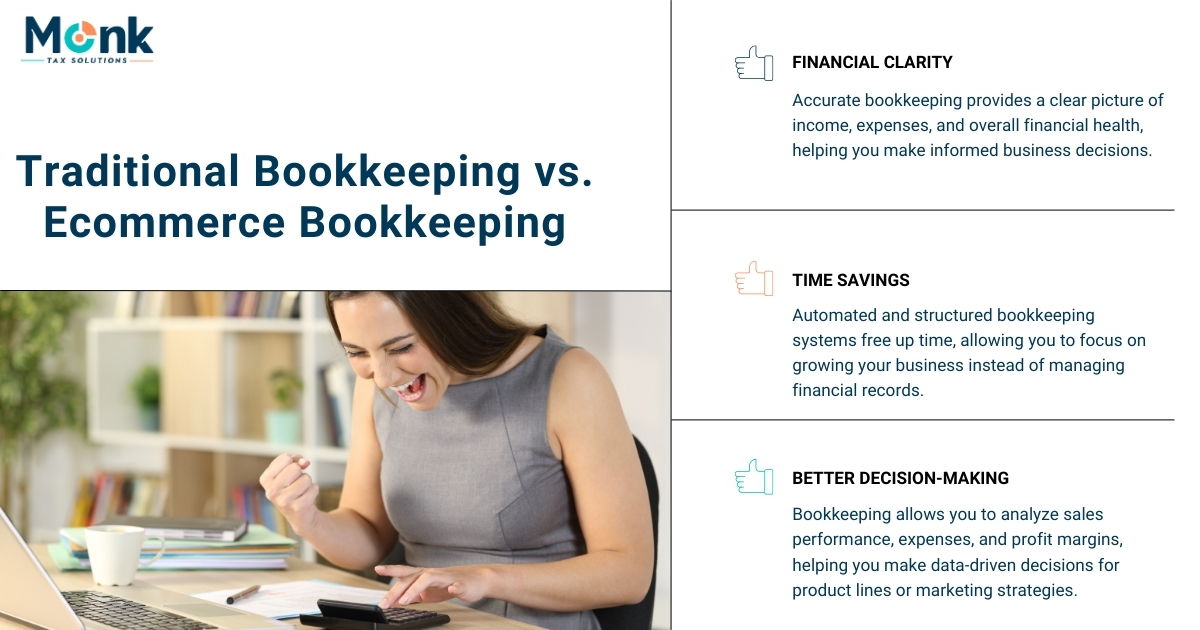
Whether your business operates from a physical location or sells online through multiple platforms, understand how to choose the right bookkeeping approach. For expert help with ecommerce bookkeeping, Monktaxsolutions offers tailored outsourcing solutions to ensure accurate financial management.

Bookkeeping is the backbone of any successful business, no matter the industry. It involves recording, tracking, and managing all financial transactions to ensure the financial health of the business. With the rise of online shopping, a new approach to bookkeeping has emerged — ecommerce bookkeeping. While traditional bookkeeping has served businesses for centuries, ecommerce bookkeeping comes with its own set of complexities.In this article, we’ll dive into the differences between traditional bookkeeping and ecommerce bookkeeping, breaking down how each method works, their challenges, and which one is best suited for your business.

What Is Traditional Bookkeeping?

Traditional bookkeeping involves recording financial transactions manually or using simple software tools for businesses that operate in physical locations or offer services offline. It usually deals with:

  • Brick-and-mortar stores
  • Service providers like salons or restaurants
  • Local or regional businesses

Key tasks in traditional bookkeeping include:

  • Tracking income from physical sales
  • Recording operating expenses like rent, utilities, and wages
  • Managing invoices, bank statements, and petty cash
  • Handling taxes and regulatory compliance based on a local or national level

What Is Ecommerce Bookkeeping?

Ecommerce bookkeeping, on the other hand, is specifically designed to handle the unique demands of businesses that operate online. Whether you’re selling on Shopify, Amazon, Etsy, or your website, ecommerce bookkeeping services covers everything from multi-channel sales to global transactions.

Key tasks include:

  • Recording sales from various platforms
  • Tracking platform fees, shipping costs, and payment processor fees
  • Managing international tax compliance
  • Handling large volumes of transactions and digital receipts

Key Differences Between Traditional and Ecommerce Bookkeeping

Scope of Business Operations

Traditional businesses operate from one or a few physical locations. In contrast, ecommerce businesses often operate on a global scale, selling products across multiple countries, time zones, and currencies. This adds complexity to ecommerce bookkeeping, requiring detailed tracking and management of different sales channels.

Tracking Revenue and Expenses

In traditional bookkeeping, revenue often comes from direct sales at a physical location. Expenses are generally limited to fixed costs like rent, utilities, and salaries. Ecommerce bookkeeping needs to handle variable costs, such as platform fees, shipping charges, and payment gateway fees.

Sales Channels and Payment Methods

Traditional businesses usually deal with cash, card, or check payments. Ecommerce businesses need to track payments from multiple processors such as PayPal, Stripe, or Amazon Pay, which involve varying fees and hold times.

Revenue Tracking: Traditional vs. Ecommerce

In traditional bookkeeping, revenue typically comes from walk-in customers or recurring service clients. However, ecommerce businesses generate revenue from multiple online platforms, often in multiple currencies, requiring complex tracking systems.

Expense Tracking: Traditional vs. Ecommerce

Traditional business expenses are often fixed and predictable. In contrast, ecommerce businesses have more dynamic expenses. These include:

  • Shipping fees
  • Platform listing fees
  • Transaction fees from payment processors
  • Marketing costs like Google Ads or Facebook Ads

Inventory Management in Traditional vs. Ecommerce Businesses

For traditional businesses, inventory management involves simple processes like physical stock counts. Ecommerce bookkeeping requires real-time tracking across multiple sales channels and warehouses, ensuring accurate inventory data is always up to date.

Handling Sales Tax in Traditional vs. Ecommerce

Sales tax is usually straightforward in traditional businesses, applied only to local customers. Ecommerce businesses need to track sales tax based on the location of the customer, which can vary greatly. For international sellers, VAT or GST might also be involved.

Multi-Channel Sales: A Major Challenge for Ecommerce Bookkeeping

Selling on multiple platforms is common in ecommerce, but it requires efficient bookkeeping to track sales across different channels. Integrating accounting software with platforms like Shopify or WooCommerce is essential to avoid errors and streamline processes.

Payment Processing: Traditional vs. Ecommerce

Traditional businesses may only need to manage payments from a few sources. Ecommerce bookkeeping, however, requires handling multiple payment processors (like Stripe, PayPal, etc.), and each has different transaction fees, refund policies, and payout schedules.

Cash Flow Management in Traditional and Ecommerce Businesses

Cash flow is simpler in traditional businesses due to predictable income and expenses. For ecommerce businesses, fluctuating sales volumes, varying payment processing times, and refunds can complicate cash flow management.

Automation in Traditional Bookkeeping vs. Ecommerce Bookkeeping

Traditional bookkeeping often involves manual entry and record keeping. Ecommerce bookkeeping relies heavily on automation tools to track revenue, expenses, and inventory across multiple channels in real time.

Reporting and Analytics: Traditional vs. Ecommerce

Traditional businesses generate standard reports like profit and loss statements. Ecommerce bookkeeping often includes advanced analytics, providing detailed insights into sales by platform, product performance, and customer behavior.

Common Mistakes in Traditional vs. Ecommerce Bookkeeping

Traditional bookkeeping mistakes often involve failing to reconcile accounts or misplacing receipts. Ecommerce businesses are prone to errors like failing to track platform fees, improper inventory valuation, or incorrect sales tax calculations.

Conclusion: Which Is Right for Your Business?

Choosing between traditional and e-commerce accounting depends on the nature of your business. If you manage a local business with physical transactions, traditional bookkeeping may suffice. However, for those operating in the online space, ecommerce bookkeeping is crucial for managing the complexities of online sales, tax compliance, and multi-channel revenue tracking. For businesses looking to simplify their ecommerce bookkeeping process, Monktaxsolutions offers specialized outsourcing services, providing expert guidance, ensuring compliance, and helping you focus on scaling your ecommerce operations efficiently.

outsourcing tax preparation services during tax season is both safe and effective? Let’s dive into the key steps and best practices.


Tax season can be a stressful time for businesses, especially when it comes to ensuring accurate and timely tax filings. With the complexity of tax regulations and the sheer volume of data to process, many businesses turn to outsourcing as a strategic solution. But how can you ensure that outsourcing tax preparation services during tax season is both safe and effective? Let’s dive into the key steps and best practices.

Understanding the Importance of Tax Preparation


Tax season brings with it a host of challenges, from managing tight deadlines to navigating the ever-changing tax laws. Businesses often find themselves stretched thin, trying to balance their regular operations with the additional burden of tax preparation. Mistakes during this period can lead to costly penalties, making it crucial to approach tax preparation with care and precision.

What Does Outsourcing Tax Preparation Involve?


Outsourcing tax preparation involves delegating the task of preparing and filing taxes to a third-party service provider. This process typically includes gathering financial data, preparing the necessary tax forms, and ensuring that filings are made on time. The service provider you choose should be well-versed in the tax laws relevant to your industry and capable of handling the complexity of your tax situation.

Types of Services You Can Outsource


Businesses can outsource a variety of tax-related services, including income tax preparation, payroll tax filings, and tax planning. Some providers also offer specialized services such as audit support and tax advisory, providing a comprehensive solution for all your tax needs.

Why Consider Outsourcing Tax Preparation Services?


Time EfficiencyOne of the most significant benefits of outsourcing tax preparation is the time it frees up. By entrusting your tax duties to professionals, you can focus on running your business, knowing that your taxes are being handled by experts.Cost-EffectivenessOutsourcing can be more cost-effective than maintaining an in-house tax team, particularly for small to medium-sized businesses. Instead of paying salaries, benefits, and training costs, you only pay for the services you need, when you need them.Access to ExpertiseTax laws are complex and constantly changing. Outsourcing gives you access to experts who stay up-to-date with the latest regulations, ensuring that your business remains compliant and takes advantage of all available deductions and credits.Minimizing Errors and RisksErrors in tax preparation can lead to audits, penalties, and even legal action. By outsourcing to professionals who specialize in tax preparation, you reduce the risk of mistakes and ensure that your filings are accurate and timely.

Comparing In-House vs. Outsourced Tax Preparation


Pros and Cons of Each ApproachIn-house tax preparation offers control and immediate access to your financial data but can be costly and time-consuming. Outsourcing, on the other hand, provides expertise and efficiency but requires trust in a third-party provider. Weighing these pros and cons will help you determine the best approach for your business.Which Option Is Right for Your Business?The decision to outsource or keep tax preparation in-house depends on your business size, the complexity of your tax needs, and your available resources. Small businesses often find outsourcing more advantageous, while larger companies with extensive financial operations may benefit from a hybrid approach.

How to Safely Outsource Tax Preparation Services


Checking Credentials and ExpertiseThe first step in safely outsourcing tax preparation is selecting a reputable service provider. Look for providers with proven experience in your industry, relevant certifications, and a strong track record of success. Don’t hesitate to ask for references or case studies that demonstrate their expertise.Reading Reviews and TestimonialsOnline reviews and testimonials can provide valuable insights into the service provider’s reliability and quality of work. Pay attention to feedback about their responsiveness, accuracy, and customer service.

Ensuring Data Security and Confidentiality


Importance of Data EncryptionYour financial data is highly sensitive, and protecting it should be a top priority. Ensure that your service provider uses robust encryption methods to secure your data, both during transmission and storage.Secure Communication ChannelsChoose a provider that offers secure communication channels, such as encrypted emails or a secure client portal, to share documents and information. This reduces the risk of data breaches and unauthorized access.

Establishing Clear Communication and Expectations


Setting Up Regular Check-InsRegular communication is key to a successful outsourcing relationship. Schedule periodic check-ins with your service provider to discuss progress, address any concerns, and ensure that deadlines are being met.Defining the Scope of Work and DeadlinesClearly define the scope of work and establish firm deadlines from the outset. This will help prevent misunderstandings and ensure that both parties are aligned on expectations.

Best Practices for Effective Outsourcing During Tax Season


Organizing Records in AdvanceBefore outsourcing, take the time to organize your financial records. Having everything in order will make the outsourcing process smoother and help your service provider work more efficiently.What Information to Provide to Your Service ProviderProvide your service provider with all the necessary documents, including income statements, receipts, and previous tax returns. The more comprehensive the information you provide, the more accurate your tax filings will be.

Managing the Outsourcing Process


Regular Monitoring and FeedbackEven after outsourcing, it’s important to stay involved. Monitor the progress of your tax preparation and provide feedback to your service provider. This will help ensure that the final product meets your expectations.Addressing Issues PromptlyIf any issues arise during the outsourcing process, address them immediately. Prompt communication can prevent small problems from becoming larger ones and ensure that your tax filings are not delayed.

Final Review and Approval of Tax Filings


How to Review Tax Documents ThoroughlyBefore your tax filings are submitted, review the documents thoroughly. Look for any discrepancies or errors, and don’t hesitate to ask your service provider for clarification on any unclear points.Ensuring Accuracy Before FilingDouble-check all the information on your tax forms before giving the final approval. This last step is crucial in ensuring that your tax filings are accurate and compliant with all regulations.

Common Pitfalls to Avoid When Outsourcing


Lack of Communication

One of the most common pitfalls in outsourcing is a lack of communication. Make sure to establish clear communication channels and maintain regular contact with your service provider.

Overlooking Data Security

Don’t overlook the importance of data security. Ensure that your service provider follows best practices in protecting your financial information.

Choosing the Cheapest Option Over Quality

While it may be tempting to choose the cheapest service provider, quality should be your top priority. Investing in a reputable provider will save you time, money, and stress in the long run.

Conclusion


Outsourcing tax preparation services through Monktaxsolutions offers a strategic solution for managing your business’s tax responsibilities, especially during the busy tax season. With Monktaxsolutions, you benefit from expert handling of your tax needs, allowing you to focus on your core business activities. By following the best practices outlined in this article, such as ensuring robust data security and maintaining clear communication, you can make the outsourcing process smooth and effective. Choose Monktaxsolutions +1–844–418–7221 for a reliable partner who will help you navigate the complexities of tax preparation with ease and precision.

As cryptocurrencies continue to gain traction in the financial landscape, tax professionals must stay ahead of the curve. The volatile and complex nature of digital assets presents unique challenges and opportunities for those in the accounting and tax sectors. Here are six essential insights for tax professionals dealing with cryptocurrency taxes, with a focus on accounting for cryptocurrency.

1. Understanding Cryptocurrency Transactions

Cryptocurrency transactions differ significantly from traditional financial transactions. They include activities like mining, staking, airdrops, hard forks, and trading on various exchanges. Each type of transaction may have different tax implications. For instance, mining rewards are generally considered taxable income at their fair market value on the date of receipt. Meanwhile, trading cryptocurrencies may trigger capital gains or losses depending on the holding period and the difference between the acquisition cost and the selling price.

Key Takeaway:

Tax professionals need to familiarize themselves with various types of cryptocurrency transactions and their respective tax treatments to provide accurate advice and compliance. Accounting for cryptocurrency transactions requires a detailed understanding of these activities.

2. Taxation of Capital Gains and Losses

Similar to stocks and other investment assets, cryptocurrencies are subject to capital gains tax. The tax rate depends on the holding period of the cryptocurrency. If the asset is held for more than one year, it qualifies for long-term capital gains tax, which is generally lower than the short-term rate applied to assets held for less than a year.

Key Takeaway:

Proper tracking of acquisition and disposal dates is crucial for determining the applicable tax rates and calculating the correct amount of capital gains or losses. Accurate accounting for cryptocurrency involves meticulous record-keeping.

3. Reporting Requirements and Documentation

The IRS has been increasing its scrutiny of cryptocurrency transactions. Taxpayers are required to report their crypto holdings and transactions accurately. This includes disclosing any income received from cryptocurrencies and maintaining thorough records of all transactions. Proper documentation is essential for substantiating the cost basis, transaction dates, and fair market value at the time of each transaction.

Key Takeaway:

Advise clients to keep detailed records of their cryptocurrency transactions, including dates, amounts, and the purpose of each transaction to ensure compliance and accurate reporting. Effective accounting for cryptocurrency demands comprehensive documentation.

4. Foreign Account Reporting

Cryptocurrencies held in foreign exchanges or wallets may be subject to the Foreign Account Tax Compliance Act (FATCA) and the Report of Foreign Bank and Financial Accounts (FBAR) requirements. Failing to report foreign cryptocurrency accounts can result in significant penalties.

Key Takeaway:

Ensure clients are aware of their obligations to report foreign cryptocurrency holdings and advise them on the necessary steps to comply with FATCA and FBAR requirements. Accounting for cryptocurrency should include considerations for international assets.

5. Treatment of Hard Forks and Airdrops

Hard forks and airdrops can create taxable events. When a cryptocurrency undergoes a hard fork, resulting in the creation of a new cryptocurrency, holders of the original cryptocurrency may receive the new currency. This receipt is typically considered taxable income. Similarly, airdrops, which involve the distribution of free tokens to holders of a particular cryptocurrency, are usually treated as taxable income upon receipt.

Key Takeaway:

Educate clients on the tax implications of receiving new cryptocurrencies through hard forks and airdrops and ensure they report this income appropriately. Proper accounting for cryptocurrency must address these unique events.

6. Navigating Regulatory Changes


The regulatory environment for cryptocurrencies is continually evolving. Tax professionals must stay updated on the latest regulatory changes and IRS guidelines. Recent developments include the IRS issuing specific guidance on cryptocurrency taxation, such as Revenue Ruling 2019–24 and updated FAQs. Staying informed about these changes will help tax professionals provide accurate and up-to-date advice to their clients.

Key Takeaway:

Regularly review IRS updates, guidance, and rulings related to cryptocurrency taxation to ensure compliance and provide clients with the latest information. Staying current is essential for accurate accounting for cryptocurrency.

Conclusion

Cryptocurrency taxation presents a complex and dynamic challenge for tax professionals. By understanding the nuances of cryptocurrency transactions, maintaining accurate records, and staying informed about regulatory changes, tax professionals can navigate this evolving landscape and provide valuable guidance to their clients. Embracing these insights will not only ensure compliance but also position tax professionals as knowledgeable advisors in the burgeoning field of digital assets. Effective accounting for cryptocurrency is critical to achieving these goals. Partner with Monktaxsolutions to ensure a smooth and compliant approach to cryptocurrency taxation. Contact us today at +1–844–318–7221 to start your journey towards financial excellence. 

Example Text

Explore how partnering with a leading outsourced tax preparation company can help businesses future-proof their tax strategy. Learn about innovative approaches and technologies that can drive long-term success and sustainability.

monktaxsolutions

In today's fast-paced business environment, staying on top of tax preparation can be a daunting task for businesses of all sizes. From navigating complex tax codes to ensuring compliance with ever-changing regulations, the process can often feel overwhelming. That's where outsource tax preparation services can make a significant difference.


Why Outsource Tax Preparation Services?


Outsourcing tax preparation services to a reputable company offers numerous benefits. Firstly, it allows businesses to offload the burden of tax preparation to experienced professionals who specialize in this field. These experts are well-versed in the intricacies of tax laws and regulations, ensuring accuracy and compliance with every filing.


Moreover, outsourcing tax preparation can lead to significant time and cost savings for businesses. Instead of dedicating internal resources to tax-related tasks, companies can allocate their time and resources towards core business activities, driving growth and profitability.


The Leading Outsourced Tax Preparation Company


When it comes to outsourcing tax preparation services, choosing the right partner is crucial. One such leading company in the US and UK is {{Company Name}}. With years of experience and a proven track record of excellence, {{Company Name}} is dedicated to providing seamless and efficient tax preparation solutions to businesses across industries.


By partnering with {{Company Name}}, businesses can expect personalized attention and customized solutions tailored to their unique needs and objectives. From tax planning and preparation to filing and compliance, {{Company Name}}'s team of experts handles every aspect of the process with the utmost professionalism and attention to detail.


The Benefits of Outsourced Tax Preparation Services

Outsourcing tax preparation services can offer a wide range of advantages for businesses. Explore the various benefits that come with delegating tax-related tasks to experienced professionals.

Tailored Tax Solutions for Every Business


Discover how outsourcing tax preparation allows businesses to access customized solutions that are tailored to their specific needs and objectives. Learn how personalized attention can make a difference in ensuring accurate and efficient tax preparation.


Maximizing Efficiency and Productivity


Explore how outsourcing tax preparation can help businesses maximize efficiency and productivity by freeing up internal resources. Learn how to streamline operations and focus on core business activities for enhanced growth and profitability.


Ensuring Compliance in a Complex Regulatory Landscape


Navigating the complexities of tax laws and regulations can be challenging for businesses. Find out how outsourcing tax preparation to a reputable company can ensure compliance with ever-changing regulatory requirements, minimizing the risk of penalties and fines.

Seamless Integration and Collaboration


Discover how outsourcing tax preparation services seamlessly integrate with existing business processes and workflows. Learn how effective collaboration between businesses and outsourcing partners can enhance overall efficiency and success.


Conclusion


In conclusion, outsource tax preparation services to a reputable company like {{Company Name}} offers businesses a hassle-free and efficient way to manage their tax-related tasks. With expert guidance and support, businesses can navigate the complexities of tax preparation with ease, ensuring compliance and maximizing savings. So why wait? Dial 📞{{+1–844(~)318(-)7221}} today and take the first step towards effortless tax preparation! give me some more headings

I BUILT MY SITE FOR FREE USING